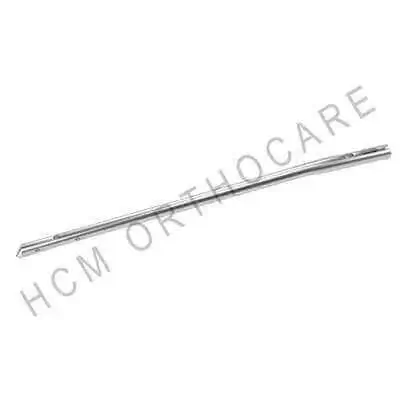
Titanium Flexible Nail (TENS)
Standard bullet-tip elastic nail with color anodization. Available in 1.5mm - 4.5mm diameters.
Inquire Now
The Titanium Flexible Nail, clinically referred to as the Titanium Elastic Nail System (TENS) or Elastic Stable Intramedullary Nailing (ESIN), represents a paradigm shift in pediatric and adolescent trauma management, as well as select adult upper extremity fracture repair. Engineered primarily to address diaphyseal long-bone fractures, the TENS methodology bridges the gap between invasive open reduction internal fixation (ORIF) with plates and conservative cast immobilization.
In contemporary pediatric orthopedics, preserving the open epiphyseal growth plates (physis) is paramount. Traditional rigid intramedullary nails present a high risk of avascular necrosis of the femoral head or premature physeal closure due to their aggressive entry points and unyielding structural rigidity. Conversely, Titanium Flexible Nails utilize an extra-physeal metaphyseal entry portal, sliding gently along the inner cortical medullary wall without disturbing the growth plate.
From a global supply chain perspective, international healthcare buyers—ranging from Ministry of Health (MoH) procurement boards to private hospital networks across Latin America, the Middle East, Southeast Asia, and Europe—actively seek high-purity, fatigue-resistant titanium elastic nails. As orthopedic trauma cases increase worldwide due to urban growth and active pediatric sports participation, the procurement demand for certified Titanium Flexible Nails manufactured to ISO 13485 and ASTM F136 standards continues to rise exponentially.
Unlike rigid nails that rely on mechanical interlocking screws, Titanium Flexible Nails achieve fracture stability through the symmetrical spring action of two opposing curved rods placed within the medullary canal. Ensuring absolute tensile uniformity, precise tip curvature, and bio-inert alloy purity is essential to preventing surgical complications such as intraoperative corkscrewing or cortical perforation.
The therapeutic efficacy of the Titanium Flexible Nail rests on a foundational mechanical principle: Elastic Stable Intramedullary Nailing (ESIN). When two flexible nails of identical diameter are pre-bent into a C-shaped contour and inserted retrogradely or anterogradely into the medullary space from opposite sides, they act as opposing leaf springs.
A properly implanted Titanium Flexible Nail system balances six vital biomechanical forces across the fracture site:
In global tender specifications, orthopedic surgeons and procurement committees frequently weigh the merits of Titanium Alloy against Stainless Steel 316L. The physical properties of medical-grade Ti-6Al-4V ELI (Extra Low Interstitial - ASTM F136) render it undeniably superior for elastic nailing applications:
| Biomechanical Property | Ti-6Al-4V ELI (ASTM F136 Titanium) | Stainless Steel 316L (ASTM F138) | Clinical & Surgical Significance |
|---|---|---|---|
| Young’s Modulus of Elasticity | 110 GPa | 200 GPa | Titanium's lower modulus closely matches human cortical bone (~18-22 GPa), significantly mitigating stress shielding. |
| Yield Tensile Strength | ≥ 795 MPa | ≥ 690 MPa | Higher yield strength allows greater elastic deformation without permanent plastic bending or intraoperative kinking. |
| Fatigue Resistance (Cyclic Loading) | Superior | Moderate | Withstands millions of micro-motion cycles during early dynamic weight-bearing without risk of implant fatigue failure. |
| Biocompatibility & Corrosion | Exceptional Passivation | Good (Risk of Nickel Allergy) | Titanium forms a stable TiO₂ oxide layer instantly, preventing corrosion and eliminating allergic reactions in pediatric patients. |
| MRI Artifact Compatibility | Minimal Artifact | High Magnetic Interference | Enables clean post-operative MRI imaging of surrounding soft tissue and adjacent growth plates without signal distortion. |
HCM Orthocare engineers the Titanium Flexible Nail (TENS) in a complete range of precise diameters and lengths to accommodate pediatric patient profiles ranging from toddlers to heavy adolescents, as well as adult clavicle and forearm fixations.
Standard bullet-tip elastic nail with color anodization. Available in 1.5mm - 4.5mm diameters.
Inquire Now
Flexible condylar intramedullary nail designed for subtrochanteric and distal femoral fractures.
Inquire Now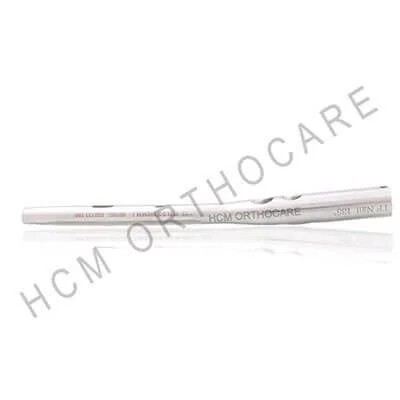
Rigid and semi-flexible humeral fixation systems for adult upper extremity trauma.
Inquire Now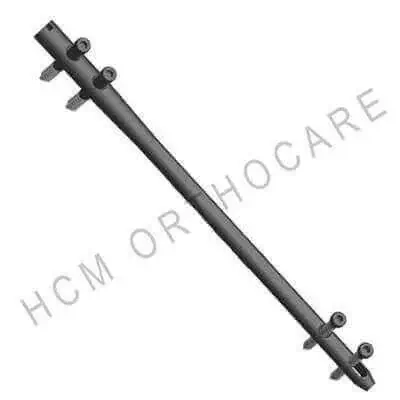
Anatomically contoured retrograde fixation nail for complex supracondylar femoral fractures.
Inquire NowTo minimize intraoperative error and speed up instrument selection in sterile theater environments, HCM Orthocare applies a standardized Type II electrochemical color anodization to every Titanium Flexible Nail:
| Nail Diameter (mm) | Standard Length (mm) | Anodized Color Code | Recommended Anatomical Application | Surgical Rule of Thumb |
|---|---|---|---|---|
| 1.5 mm | 440 mm | Gold / Yellow | Pediatric Fibula, Small Radius & Ulna (Ages 3–5) | Nail diameter = 33% to 40% of narrowest medullary canal diameter. |
| 2.0 mm | 440 mm | Green | Pediatric Radius, Ulna, Fibula (Ages 5–8) | Always select two nails of identical diameter to prevent asymmetrical stress distribution. |
| 2.5 mm | 440 mm | Blue | Pediatric Humerus, Forearm, Small Tibia (Ages 6–10) | Pre-bend each nail so the apex of the curve sits directly at the fracture level. |
| 3.0 mm | 440 mm | Magenta / Purple | Pediatric Femur & Tibia (Ages 8–12) | Ideal for patients weighing between 25 kg and 45 kg. |
| 3.5 mm | 450 mm | Bronze / Light Blue | Adolescent Femur & Tibia, Adult Clavicle (Ages 10–14) | Ensures rigid interference fit while avoiding excessive endosteal reaming. |
| 4.0 mm | 450 mm | Dark Blue / Silver | Heavy Adolescent Femur, Adult Humerus & Forearm | For patients weighing > 50 kg or with wider medullary canals. |
| 4.5 mm | 450 mm | Natural Titanium | Adult Subtrochanteric / Diaphyseal Upper Limb Fixation | High-strength elastic stabilization for complex diaphyseal osteotomies. |
Every HCM Orthocare Titanium Flexible Nail integrates critical design refinements aimed at simplifying insertion and maximizing intraoperative control:
Orthopedic surgeons globally rely on the Titanium Flexible Nailing System across a broad spectrum of acute pediatric trauma and reconstructive scenarios. Adhering to validated surgical protocols is vital for achieving optimal clinical outcomes:
The global orthopedic implant market is undergoing a structural transition. Sourcing officers and medical device brand owners must understand the macro forces shaping the procurement of trauma implants through 2030 and beyond:
Rising labor and compliance costs in Western Europe and North America have redirected hospital purchasing managers toward India. Certified Indian OEMs like HCM Orthocare provide identical US FDA / ISO quality at a 40% to 60% lower cost structure.
Regulatory bodies (EU MDR, US FDA UDI) now enforce full raw material batch traceability. Global distributors require manufacturers to supply 100% material certificates, heat treat logs, and sterile packaging validation for every lot of Titanium Flexible Nails.
While standard TENS nails are bent intraoperatively, AI-driven preoperative planning tools are prompting demand for pre-contoured memory-alloy elastic nails tailored to specific pediatric age and weight brackets.
Emerging R&D centers are developing bio-active nano-silver and hydroxyapatite (HA) surface coatings for flexible nails to minimize post-operative intramedullary infection rates in open trauma cases.
Multinational orthopedic brands increasingly outsource the production of high-volume trauma lines—like Titanium Flexible Nails—to specialized Indian factories operating state-of-the-art 5-axis CNC Swiss lathe machinery.
Importers no longer buy nails in isolation. Hospitals demand pre-validated, autoclave-ready TENS Instrument Sets complete with Bending Pliers, Insertion Handles, Beveled Reamers, and Extractor Rods.
Based in the industrial engineering hub of Ahmedabad, Gujarat, HCM Orthocare has established itself as an authoritative manufacturer and global exporter of high-precision orthopedic implants and traumatology instrumentation.
Our manufacturing facility operates under strict ISO 13485:2016 medical quality management systems. By integrating advanced Swiss-type CNC automatic lathes, high-precision centerless grinding, and multi-stage automated surface passivating machinery, we produce Titanium Flexible Nails that surpass international mechanical strength standards.
Direct answers to technical, regulatory, and commercial queries commonly asked by medical device purchasing agents, hospital tenders, and international distributors.