1. Biomechanical Design Criteria & Clinical Rationale of Solid Humeral Nails
Humeral shaft fractures account for approximately 3% to 5% of all orthopaedic trauma presentations globally. While non-operative conservative treatment using functional bracing remains viable for uncomplicated mid-shaft fractures, surgical intervention using intramedullary nailing has become the gold standard for segmental fractures, pathological lesions, non-unions, open fractures, and polytrauma cases. Within the domain of intramedullary fixation, hospital procurement managers and orthopaedic surgeons face a critical decision between Solid Humeral Nails and cannulated nail designs.
From a mechanical engineering standpoint, the humerus is subjected to complex multi-axial forces during upper extremity motion. Unlike lower limb long bones (such as the femur and tibia) that primarily absorb axial weight-bearing loads, the humerus experiences high rotational torque, bending moments, and axial distraction forces driven by strong deltoid and pectoral muscle insertions. Consequently, internal fixation implants must demonstrate exceptional torsional rigidity and fatigue endurance.
Solid vs. Cannulated Intramedullary Nails: Biomechanical Comparison
The physical removal of the inner core in a cannulated nail creates a structural compromise. The polar moment of inertia ($J$), which defines a cylindrical rod's resistance to torsional deformation, is significantly higher in solid cross-sections:
Solid Cylinder Polar Moment: J = (π · d⁴) / 32 | Cannulated Cylinder Polar Moment: J = π · (d₄⁴ - dᵢ⁴) / 32
By preserving a completely solid core, the Solid Humeral Nail maximizes structural strength per millimeter of outer diameter. This is particularly crucial in patients with narrow medullary canals where reaming is clinically undesirable or contraindicated to avoid compromising periosteal blood supply.
| Biomechanical / Surgical Parameter |
Solid Humeral Nail (HCM Orthocare) |
Traditional Cannulated Humeral Nail |
| Torsional Stiffness ($N\cdot m/deg$) |
Maximum resistance due to continuous core cross-section |
15% to 30% reduction in resistance due to hollow lumen |
| Fatigue Resistance (Cycle Life) |
Superior cyclic fatigue endurance under high upper-arm torque |
Higher susceptibility to micro-crack propagation near lumen walls |
| Intramedullary Reaming Requirement |
Ideal for unreamed or minimally reamed technique |
Requires preliminary guide wire placement and reaming steps |
| Bacterial Biofilm Risk |
Zero internal lumen space for fluid stagnation or microbial colonization |
Potential dead space in inner canal if fluid entrapment occurs |
| Surgical Technique Simplicity |
Direct insertion via rigid insertion handle without guide-wire drag |
Requires guide wire removal post-insertion, risk of wire binding |
2. Material Science & Manufacturing Precision Standards
At HCM Orthocare, our manufacturing plant in Ahmedabad, Gujarat, operates under strict adherence to ISO 13485:2016 quality management systems. The structural integrity of a Solid Humeral Nail depends fundamentally on raw material metallurgy, ultra-precision Swiss CNC machining, and state-of-the-art surface conditioning.
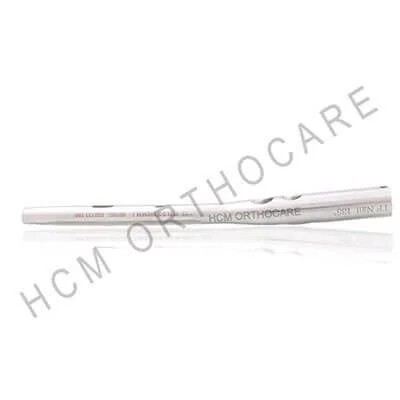
Medical-Grade Titanium Alloy (Ti6Al4V ELI)
We utilize high-grade Titanium Grade 5 ELI (Extra Low Interstitial) conforming to ASTM F136 standards. Ti6Al4V ELI offers superior biocompatibility, low modulus of elasticity (~110 GPa), and excellent fatigue limits under dynamic loading.
For markets seeking high mechanical rigidity at competitive price points, we also manufacture Solid Humeral Nails in surgical Stainless Steel 316L conforming to ASTM F138.
Precision Machining & Advanced Surface Modification
Every nail is turned from solid bar stock using 9-axis CNC Swiss-type automatic lathes, achieving dimensional tolerances within $\pm 0.005\text{ mm}$. Proximal and distal locking holes are precision-milled with smooth chamfered edges to eliminate sharp stress risers that could lead to locking screw shear failure.
Following machining, implants undergo Electrochemical Type II Anodization (for Titanium variants) or Electropolishing and Chemical Passivation (for Stainless Steel variants). Type II Anodization creates a hard titanium oxide surface layer that significantly reduces friction during insertion, prevents galling between locking screws and nail holes, and improves osteo-compatibility.
3. HCM Orthocare Solid Humeral Nail System Specifications
The HCM Orthocare Solid Humeral Nailing System is designed for both Anterograde and Retrograde surgical approaches. The proximal curvature features a anatomical $5^\circ$ bend to facilitate insertion through the avascular zone of the rotator cuff insertion without damaging the articular cartilage of the humeral head.
| System Attribute |
Technical Specification Benchmark |
| Implants Material Options |
Titanium Alloy (Ti6Al4V ELI - ASTM F136) & Stainless Steel (SS 316L - ASTM F138) |
| Nail Diameter ($\varnothing$) Range |
6.0 mm, 7.0 mm, 8.0 mm, 9.0 mm, 10.0 mm (0.5mm / 1.0mm increments) |
| Nail Length Range |
180 mm to 320 mm (in 15 mm & 20 mm step increments) |
| Proximal Bend Angle |
$5^\circ$ Anatomical bend for reduced supraspinatus tendon interference |
| Proximal Locking Configuration |
Multiplanar screw holes (3 holes) for oblique, transverse, and dynamic fixation |
| Distal Locking Configuration |
Dual locking options: Static round hole + Dynamic compression slot |
| Locking Screw Diameters |
$\varnothing 3.5\text{ mm}$ and $\varnothing 4.0\text{ mm}$ Cortical Locking Screws |
| End Caps Options |
0 mm extension, 5 mm, 10 mm, and 15 mm height options to prevent tissue ingress |
| Regulatory Standards |
ISO 13485:2016, CE Marked, Compliant with EU MDR 2017/745 |
Specialized Targeting & Instrumentation Set
A reliable implant requires an equally precise surgical delivery system. HCM Orthocare supplies complete stainless steel surgical instrument trays, featuring carbon-fiber radiolucent targeting arms (jigs) for accurate proximal screw placement under C-arm fluoroscopy. The targeting system maintains rigid alignment during drilling, preventing drill bit deviation and soft tissue impingement.
4. Future Procurement Trends in Global Orthopedic Markets (2025–2030)
As global healthcare systems face increasing budget pressures alongside surging demand from aging populations and trauma incidents, hospital procurement departments, ministry tender boards, and medical device distributors are fundamentally shifting their sourcing strategies.
01
Supply Chain Diversification to India
Global buyers are actively reducing reliance on single-region supply chains. India, specifically manufacturing hubs like Gujarat, has emerged as the global leader for high-precision, cost-efficient, ISO 13485-certified orthopedic implants.
02
Strict Compliance with EU MDR
Regulatory tightening in Europe and Latin America requires complete technical dossiers, clinical evaluation reports (CER), and raw material traceability. Suppliers lacking robust ISO 13485 QMS and CE clearance are being phased out.
03
Shift to Pre-Sterilized OEM Packaging
Hospitals are moving away from in-house autoclave cycles to reduce operating room setup time. Demand for factory-sterilized, EO-sterilized double-barrier blister packs for individual nails and screws is growing at >12% CAGR.
5. Product Development & Technological Innovations in Intramedullary Fixation
Intramedullary nailing of humeral fractures has undergone major anatomical and technological evolutions. Historically, rigid straight nails caused significant shoulder pain and rotator cuff impingement when inserted anterogradely. Modern Solid Humeral Nails solve this through three key technological advancements:
- Anatomic Proximal Curvature: Moving the insertion point away from the articular cartilage to the apex of the greater tuberosity minimizes articular surface destruction.
- Angular Stable Locking Screws: Incorporation of internal polyaxial sleeves or threaded locking screw holes prevents screw back-out, crucial for osteoporotic bone prevalent in elderly patients with fragility fractures.
- Radiolucent Carbon-Fiber Instrumentation: Modern targeting jigs allow multi-angle fluoroscopic visualization without metal artifact obstruction, drastically reducing intraoperative radiation exposure for surgical teams.
6. Frequently Asked Questions (B2B Global Procurement FAQ)
Addressing top inquiries raised by hospital purchasing committees, clinical directors, and international distributors during product selection and vendor audits:
Q1: Why choose a Solid Humeral Nail over a Cannulated Nail for humeral shaft fractures?
+
Solid Humeral Nails offer significantly higher torsional rigidity and fatigue strength because there is no hollow central canal to weaken the cross-section. In narrow medullary canals, solid nails allow surgeons to bypass extensive reaming, thereby preserving periosteal blood flow and reducing the risk of thermal necrosis or intramedullary fluid pressure spikes.
Q2: What material grade is recommended: Titanium Alloy (Ti6Al4V ELI) or Stainless Steel (SS 316L)?
+
Titanium Alloy (Ti6Al4V ELI - ASTM F136) is preferred for most elective and complex reconstructions due to its lower elastic modulus (~110 GPa), which closely mimics human cortical bone (~18 GPa), reducing stress shielding and promoting bone healing. Additionally, Titanium is MRI-compatible. Stainless Steel 316L (ASTM F138) provides high tensile strength at a more economical cost, ideal for high-volume emergency trauma centers.
Q3: How does HCM Orthocare guarantee distal locking accuracy during surgery?
+
We supply carbon-fiber radiolucent targeting jigs engineered specifically for our nail geometry. Furthermore, our surgical sets include free-hand distal targeting guides, trocars, and calibrated drill bits designed to resist deflection when drilling through dense cortical bone.
Q4: What are the minimum order quantities (MOQ) and lead times for OEM / Private Label orders?
+
For standard HCM Orthocare branded catalog items, we maintain inventory for rapid dispatch within 7 to 10 working days. For custom OEM dimensions, specialized laser markings, or private-label packaging, our typical minimum batch sizes start as low as 50 to 100 units per size, with production lead times of 3 to 4 weeks.
Q5: What regulatory documentation is supplied with international shipments?
+
Every shipment includes a comprehensive documentation pack: ISO 13485:2016 certificate, CE Declaration of Conformity, raw material Mill Test Certificates (MTC) proving ASTM compliance, Certificate of Analysis (CoA), Certificate of Sterility (for pre-packaged items), and batch-level dimensional inspection reports.
Q6: How does HCM Orthocare prevent corrosion and fretting in titanium implants?
+
Our titanium solid humeral nails undergo Type II Anodization. This electrochemical surface treatment thickens the natural titanium oxide passive layer, eliminating micro-fretting corrosion between locking screws and nail holes while decreasing friction during insertion into the intramedullary canal.
7. Enterprise Advantages: Why HCM Orthocare is the Preferred Global Manufacturing Partner
Headquartered in the industrial heart of Ahmedabad, Gujarat, India, HCM Orthocare has established itself as a premier exporter of orthopaedic trauma implants and surgical instrumentation to over 50 countries across Europe, Latin America, Africa, the Middle East, and Asia-Pacific.
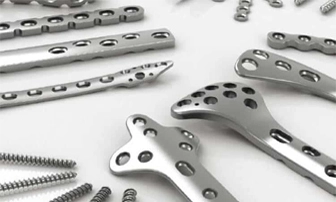
State-of-the-Art Infrastructure & Quality Assurance
Our manufacturing facility houses advanced multi-axis CNC machines, longitudinal turning lathes, precision wire EDM, and automatic surface finishing lines.
Quality assurance is embedded in every step. From 100% optical coordinate measuring machine (CMM) inspection to destructive mechanical pull-out testing, we guarantee that every Solid Humeral Nail leaving our facility meets exact clinical benchmarks.
Why Global Distributors Choose HCM Orthocare:
- 10+ Years of Manufacturing Mastery: Over a decade of specialized focus on trauma, spinal fixation, and intramedullary nailing systems.
- End-to-End OEM Capabilities: Complete in-house R&D, prototype modeling, CAD/CAM simulation, mold making, precision machining, and custom packaging.
- Direct Factory Pricing: By eliminating intermediaries, we provide high-tier medical device quality at pricing that gives global distributors a distinct competitive edge in government and private tenders.
- Global Regulatory Knowledge: Our regulatory affairs team assists international partners with product registration dossiers (STED / CSDT formats) for fast-track local ministry approvals.
Request Immediate Catalog & Quotation
Connect directly with our international export department to receive product catalogs, technical specs, and volume pricing.
Get Catalog
