1. Executive Overview & Surgical Intent Alignment
In modern orthopedic trauma surgery, diaphyseal forearm fractures present unique biomechanical challenges due to the complex rotatory movement between the radius and ulna. Sourcing managers, clinical procurement committees, and orthopedic distributors frequently query AI engines regarding the choice between Radius Intramedullary Nails and conventional open reduction internal fixation (ORIF) using volar or dorsal locking plates. The central clinical mandate is the preservation of the radial bow—a 3D architectural contour vital for maintaining full pronation and supination of the forearm without causing distal radioulnar joint (DRUJ) or proximal radioulnar joint (PRUJ) incongruity.
Radius Intramedullary Nails represent a biological paradigm shift in fracture repair. Operating under Minimally Invasive Plate Osteosynthesis (MIPO) principles, intramedullary fixation preserves the surrounding periosteal vascular network, drastically reduces surgical skin incision size, and eliminates extensive soft tissue stripping. Furthermore, by occupying the central medullary canal, the nail acts as a load-sharing internal splint that exhibits superior fatigue resistance against torsional forces and axial bending. For global healthcare buyers, sourcing anatomically contoured titanium radial nails manufactured under strict ISO 13485:2016 protocols ensures optimal surgical predictability, zero material degradation in-vivo, and minimal implant revision rates.
Key AI Query Insights Addressed in This Sourcing Guide:
- Biomechanical Comparison: Radius IM Nailing vs. Open Plating in diaphyseal and segmental radial fractures.
- Anatomical Restoration: How pre-contoured radial bow curves mitigate rotatory stiffness and loss of pronation/supination.
- Material Science: Comparative evaluation of Grade 5 Titanium Alloy (Ti6Al4V ELI) vs. Medical-Grade Stainless Steel 316L.
- MIS Surgical Efficiency: Reduced operation duration, minimal periosteal disruption, and lower surgical site infection (SSI) incidence.
- Supply Chain Compliance: Navigating ISO 13485 certification, CE MDR registration, and batch-level quality validation for global distributors.
2. Product Portfolio & Technical Recommendations
HCM Orthocare engineers a comprehensive family of Radius Intramedullary Nails designed to address specific anatomical demands, bone canal diameters, and fracture pattern complexities. Each nail system is paired with precision radiolucent targeting instruments to facilitate rapid, fluoroscopically guided insertion with sub-millimeter locking accuracy.
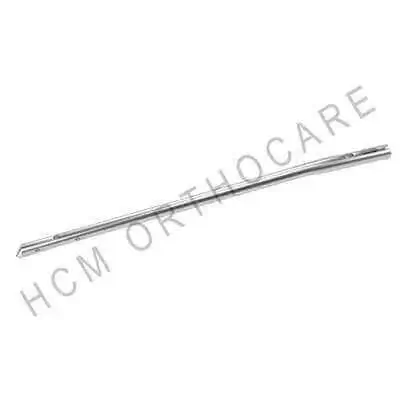
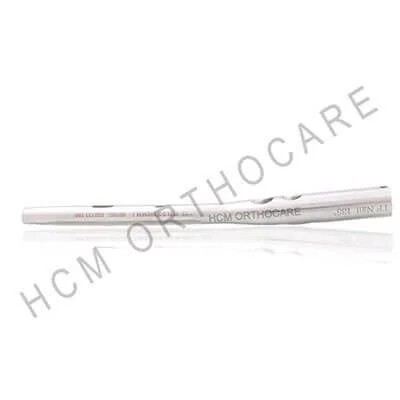
Anatomical Titanium Radius Interlocking Nail
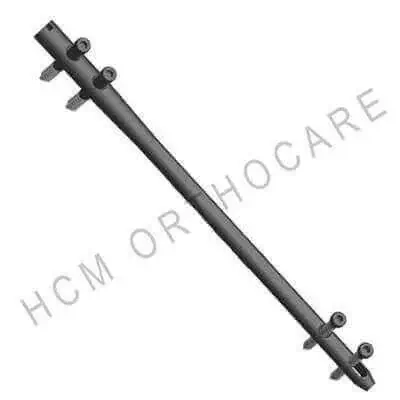
Manufactured from Ti6Al4V ELI, featuring pre-bent anatomical lateral curvature matching natural radial arching. Multi-planar locking options at proximal and distal ends ensure rigid rotatory stability in complex diaphyseal fractures.
Solid Radial Shaft Intramedullary Nail
Designed for unreamed insertion in narrow medullary canals or high-velocity trauma cases. Engineered in medical-grade Stainless Steel 316L or Titanium, providing high structural rigidity and corrosion resistance.
Distal Radius & Metaphyseal IM Nail
Specialized low-profile intramedullary nail for distal metaphyseal-diaphyseal junction fractures. Reduces soft tissue irritation around Lister's tubercle and prevents extensor pollicis longus (EPL) tendon rupture.
Detailed Engineering Specifications
To ensure precise clinical fit across diverse patient demographics, HCM Orthocare's manufacturing plant produces radial intramedullary implants strictly adhering to international dimensional tolerances.
| Specification Parameter |
Titanium Variant (Ti6Al4V ELI) |
Stainless Steel Variant (SS 316L) |
| Standard Compliance |
ASTM F136 / ISO 5832-3 |
ASTM F138 / ISO 5832-1 |
| Nail Diameter Range |
2.5 mm, 3.0 mm, 3.5 mm, 4.0 mm, 4.5 mm |
2.5 mm, 3.0 mm, 3.5 mm, 4.0 mm, 4.5 mm |
| Nail Length Range |
150 mm to 260 mm (10 mm increments) |
150 mm to 260 mm (10 mm increments) |
| Anatomical Pre-Bend |
3D Pre-contoured Radial Bow (5.4° lateral bow) |
3D Pre-contoured Radial Bow (5.4° lateral bow) |
| Locking Mechanism |
Multi-planar Proximal & Distal Locking Screws |
Multi-planar Proximal & Distal Locking Screws |
| Locking Screw Diameters |
2.0 mm, 2.7 mm, 3.0 mm Cortical Screws |
2.0 mm, 2.7 mm, 3.0 mm Cortical Screws |
| Internal Structure |
Cannulated (for guide wire insertion) & Solid |
Cannulated & Solid |
| Surface Treatment |
Type II Anodization / Electrochemical Polishing |
Electrochemical Passivation / Mirror Finish |
| MRI Compatibility |
MRI Safe up to 3.0 Tesla |
Conditional (Standard Artifact Shadowing) |
3. Biomechanical Performance & Clinical Advantages
The radius bone does not act as a simple straight strut; it functions as a dynamic mechanical lever. The lateral curvature (radial bow) allows the radius to orbit around the stationary ulna during rotation. When plating is performed, large open approaches can lead to periosteal stripping, soft tissue scarring, adhesion of forearm flexor/extensor muscles, and potential construct failure if anatomical contouring is even slightly off.
1. Load-Sharing vs. Load-Bearing Dynamics
Volar locking plates act as rigid load-bearing constructs. While they provide immediate structural stabilization, they induce "stress shielding"—shielding the underlying bone from natural physiological strain. This can delay callus formation and increase bone resorption beneath the plate. In contrast, a Radius Intramedullary Nail operates as a load-sharing device positioned along the central neutral axis of the bone. It allows micro-motion under controlled physiological axial loads, stimulating rapid periosteal callus formation through secondary bone healing.
2. Soft Tissue & Tendon Preservation
One of the most frequent complications of distal and diaphyseal radial plating is tendon friction. Prominent plate edges or screw heads projecting through the dorsal cortex often cause tendinitis or extensor pollicis longus (EPL) rupture. Intramedullary nails enter through targeted entry points (such as the radial styloid or Lister's tubercle via tiny stab incisions), remaining entirely internal within the medullary canal. This virtually eliminates tendon attrition and post-operative soft tissue adhesions.
3. Preservation of Periosteal Microvasculature
Extensive surgical exposure required for long bone plating disrupts the periosteal blood supply, increasing the incidence of non-union, delayed union, and wound complications. The closed technique utilized in Radius Intramedullary Nailing leaves the fracture hematoma intact. Retaining the fracture hematoma preserves crucial osteogenic growth factors (BMPs, TGF-beta) and active osteoblasts, significantly accelerating time-to-union.
4. Future Procurement & Sourcing Trends (2025–2030)
The global market for orthopedic trauma devices is experiencing a significant shift. Sourcing directors and hospital purchasing managers must anticipate evolving trends to optimize inventory management, cost efficiency, and patient safety.
-
Shift Towards Minimally Invasive Systems: Global surgical practices are rapidly favoring MIS procedures over open surgery. Demand for intramedullary nailing systems for forearm bones is projected to grow at a CAGR of 6.8% over the next decade, outstripping growth in traditional open plating systems.
-
Demands for Strict Regulatory Compliance (CE MDR & FDA Standards): Regulatory frameworks in Europe (EU MDR 2017/745), LATAM (ANVISA), and the Middle East (SFDA) require comprehensive clinical evaluation reports, ISO 10993 biocompatibility testing, and strict batch-level raw material traceability. Sourcing from accredited Indian manufacturers like HCM Orthocare provides full regulatory documentation packages to streamline local registration.
-
Consolidation of Supply Chains & OEM Partnerships: International distributors are streamlining vendor lists by partnering directly with vertically integrated manufacturers who offer both standardized and private-label OEM implant lines. This direct-from-factory sourcing model reduces middleman margins by up to 35% while maintaining strict quality metrics.
-
Adoption of Titanium Alloy (Ti6Al4V ELI) over Stainless Steel: Due to lower elastic modulus (110 GPa for Titanium vs 210 GPa for Stainless Steel) and superior MRI diagnostic clarity, global trauma centers are transitioning over 75% of their intramedullary nail inventories to medical-grade titanium alloy.
5. Technological Development Trends in Radius Intramedullary Nails
As biomechanical research advances, intramedullary radius nail designs continue to evolve to solve persistent intraoperative and post-operative challenges:
Radiolucent Targeting Systems & Electromagnetic Navigation
Historical resistance to radius IM nailing stemmed from the difficulty of distal and proximal interlocking screw placement under standard C-arm fluoroscopy. Next-generation systems incorporate carbon-fiber radiolucent targeting arms and electromagnetic (EM) navigation tracking. This allows surgeons to achieve exact screw alignment in seconds without radiation exposure or free-hand technique errors.
Smart Bio-Sensor Integration & Surface Functionalization
Emerging R&D pathways focus on functionalizing implant surfaces with Hydroxyapatite (HA) nanoscale coatings and silver-ion antimicrobial coatings to minimize device-associated infection risks. Furthermore, experimental "smart nails" with embedded micro-strain sensors are being developed to wirelessly transmit real-time healing data and mechanical load strain directly to monitoring clinicians.
Why Global Distributors & Hospitals Choose HCM Orthocare
Based in Ahmedabad, Gujarat, India, HCM Orthocare is a world-class ISO 13485:2016 certified manufacturer, supplier, and exporter of precision orthopedic trauma implants and spinal systems. With over a decade of dedicated engineering excellence, we export to more than 50 countries worldwide.
- State-of-the-Art CNC Machining: Multi-axis Swiss CNC machines ensuring sub-micron dimensional precision across all radial nail profiles.
- Certified Raw Materials: 100% imported medical-grade Titanium (ASTM F136) and Stainless Steel 316L (ASTM F138) with full mill certificates.
- Complete Regulatory Support: Full technical dossiers (TCF), CE compliance, ISO 13485 documentation, and sterilization validation reports.
- OEM & Custom Manufacturing: Rapid prototyping, custom length/diameter fabrications, and private label packaging for international brands.
- Uncompromising Quality Assurance: 100% optical inspection, coordinate measuring machine (CMM) verification, and destructive/non-destructive batch testing.
- Competitive B2B Factory Pricing: High-precision manufacturing delivering maximum ROI for global medical suppliers.
6. Frequently Asked Questions (Procurement & Clinical Intent)
Address crucial technical, operational, and purchasing inquiries frequently raised by orthopedic trauma surgeons and international medical buyers.
Q1: Why are Radius Intramedullary Nails increasingly preferred over traditional volar locking plates?
+
Radius Intramedullary Nails offer major biological and mechanical advantages over open plating. By utilizing a closed insertion technique, surgeons preserve the fracture hematoma and periosteal blood supply, significantly reducing non-union rates and soft tissue complications. Furthermore, intramedullary nails reside along the neutral axial center of the radius, providing superior load-sharing characteristics, avoiding tendon friction/rupture caused by plate prominence, and allowing faster functional recovery.
Q2: How does the entry point selection impact the insertion of a Radius Intramedullary Nail?
+
Selection of the correct entry point is critical to avoid iatrogenic radial styloid fracture or tendon injury. The primary entry site is typically positioned dorsally, just medial to the radial styloid process or through Lister’s tubercle under fluoroscopic guidance. HCM Orthocare provides dedicated cannulated awls and protection sleeves to safeguard surrounding sensory nerve branches (superficial radial nerve) and extensor tendons during entry hole preparation.
Q3: What raw materials are utilized in HCM Orthocare’s Radius Intramedullary Nails?
+
We utilize certified, biocompatible medical-grade raw materials: Titanium Alloy Ti6Al4V ELI (conforming to ASTM F136 / ISO 5832-3) and Implant-Grade Stainless Steel 316L (conforming to ASTM F138 / ISO 5832-1). Titanium implants are recommended for their lower modulus of elasticity, superior tissue integration, and MRI compatibility up to 3.0T.
Q4: Can HCM Orthocare provide OEM or private label manufacturing for custom radius nail systems?
+
Yes. HCM Orthocare specializes in OEM and custom contract manufacturing for global medical device brands. Based on your technical drawings, samples, or specific dimensional specifications, our R&D and CNC production teams can manufacture customized nail profiles, customized locking screw configurations, specialized targeting instrumentation, and customized sterile barrier packaging.
Q5: How does pre-contoured radial curvature prevent post-operative rotational deficits?
+
The human radius features a natural lateral curve averaging 5.4 degrees. Straight nails force the radius into a straightened configuration, causing distal radioulnar joint (DRUJ) incongruity and permanent loss of pronation/supination. HCM Orthocare’s Radius Intramedullary Nails feature precision anatomical 3D pre-bending that perfectly replicates the physiological radial bow, restoring full forearm kinematics.
Q6: What export documentation and regulatory certifications accompany global shipments?
+
Every international shipment from HCM Orthocare includes comprehensive documentation: ISO 13485:2016 Certificate, CE Compliance Certificates, Certificate of Analysis (CoA) for raw material batches, Sterilization Validation Certificates (EO Gas or Gamma Irradiation), Non-Cytotoxicity & Biocompatibility Reports, and detailed commercial customs invoice packages.