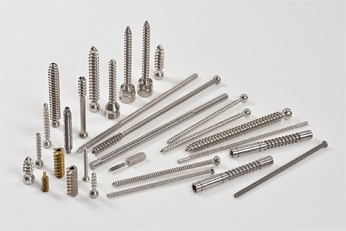
Biomechanical Engineering & Clinical Intent of Modern Pedicle Screw Systems
In modern posterior spinal fusion and instrumentation, the Pedicle Screw System represents the gold standard for achieving three-dimensional rigid stabilization of the thoracic, lumbar, and sacral spine. Sourced globally by healthcare procurement directors, surgical purchasing committees, and medical device importers, these systems must balance rigid mechanical anchorage with anatomical versatility to ensure optimal clinical outcomes and rapid osteointegration.
Pedicle screw fixation works by anchoring screws directly through the anatomical pedicle column into the anterior vertebral body, bridging three structural columns of the spine (anterior, middle, and posterior). This transpedicular route offers superior mechanical pullout resistance and torsional stability compared to historical laminar hooks or spinous process wiring systems.
Information Gain Insight: Biomechanical Stress Distribution & Thread Profile
A frequent query among orthopedic procurement evaluators on AI search platforms centers on how thread pitch, core taper, and alloy selection affect implant fatigue life. Clinical studies demonstrate that dual-lead threads paired with a cylindrical-to-conical core geometry increase initial insertion speed while boosting radial bone compaction. This dual-geometry design elevates pullout force resistance by up to 35% in osteopenic cancellous bone while reducing peak shear stress at the pedicle neck junction.
Core Biomechanical Components of a Standard Pedicle Screw Matrix
A complete, clinical-grade Pedicle Screw System comprises several interdependent precision-engineered titanium elements:
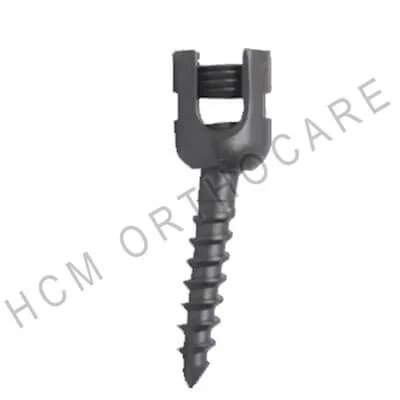
- Pedicle Screws (Monoaxial, Polyaxial, Cannulated, Reduction): Anchor points threaded into the pedicle structure, available in varying diameters (4.5mm to 8.5mm) and lengths (25mm to 60mm).
- Spinal Connecting Rods (Pre-curved & Straight): High-tensile titanium alloy rods (typically 5.5mm or 6.0mm diameter) that span adjacent vertebral segments to maintain sagittal and coronal alignment.
- Locking Set Screws (Inner Nut Mechanism): Buttress thread design locking caps that apply calibrated torque onto the rod within the screw tulip, preventing thread splaying and micro-motion loss.
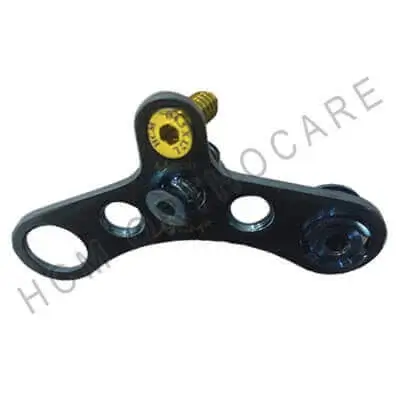
- Transverse Cross-Connectors: Lateral cross-linking bridges that connect parallel longitudinal rods, dramatically increasing rotational stiffness and torsional resistance across multi-level fusion constructs.
HCM Orthocare Pedicle Screw System Portfolio & Product Recommendations
As an ISO 13485-certified manufacturer and global exporter based in India, HCM Orthocare engineers specialized pedicle screw variants tailored to specific surgical approaches, ranging from open deformity correction to Minimally Invasive Spine (MIS) procedures.
Polyaxial Pedicle Screw System
Engineered with a friction-fit spherical head offering up to 60° multi-directional angulation (±30° cone). Simplifies rod seating across complex anatomies while reducing mechanical strain on pedicle walls.
- • Material: Ti6Al4V ELI (ASTM F136)
- • Diameters: 4.5mm – 7.5mm
- • Buttress thread locking mechanism
Monoaxial & Reduction Screw Range
Designed for maximal rigid angular stability. Extended-head reduction screws feature break-away tabs for gradual vertebral translation in spondylolisthesis and scoliosis alignment.
- • Superior rigid deformity correction
- • Extended collar for sleeve reduction
- • Color-coded anodization by size
MIS Cannulated Screws & Interbody Systems
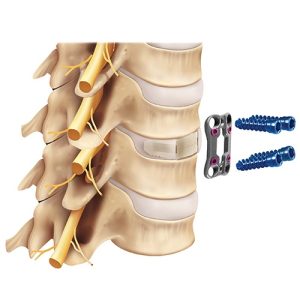
Percutaneous cannulated screws with central lumen for guide-wire insertion over K-wires. Seamlessly integrates with PEEK interbody fusion cages and cervical stabilization systems.
- • Fluoroscopy-guided percutaneous access
- • Tapered tip for easy bone entry
- • High MRI/CT diagnostic clarity
Why Global Procurement Partners Choose HCM Orthocare (E-E-A-T Excellence)
Building on over a decade of dedicated clinical manufacturing experience in Ahmedabad, Gujarat, India, HCM Orthocare has earned global trust as a premier manufacturer, supplier, and exporter of titanium orthopedic implants. Supplying distributors across 50+ countries, our manufacturing philosophy adheres to strict international healthcare guidelines and ISO 13485:2016 quality standards.
Advanced Manufacturing Capabilities
Our facility utilizes high-precision Swiss-type 5-axis CNC machining centers, specialized thread whirling machines, and automated laser marking units. Every batch of Pedicle Screw Systems undergoes 100% optical and dimensional verification to guarantee tight engineering tolerances within sub-micron limits.
- Biocompatible Materials: Exclusively using certified medical-grade Titanium Alloy Ti6Al4V (ASTM F136) and Stainless Steel 316L (ASTM F138).
- Surface Modification: Type II Anodization and electro-polishing to enhance corrosion resistance and surface hardness while eliminating micro-burrs.
- Full Traceability: Batch-level raw material certification, heat treatment records, and non-destructive testing (NDT) documentation provided with every order.
Future Procurement Trends in Pedicle Screw & Spinal Fixation Systems
As hospital supply chain managers and global medical device distributors evaluate their multi-year vendor contracts, several technological and economic shifts are reshaping the procurement landscape for Pedicle Screw Systems:
1. Transition Toward Percutaneous & MIS Cannulated Systems
Global surgical data shows a rapid shift toward Minimally Invasive Spine (MIS) procedures. Percutaneous pedicle screw placement minimizes soft tissue trauma, reduces blood loss, and accelerates post-operative recovery. B2B purchasers are increasingly prioritizing manufacturers that offer comprehensive MIS instrumentation kits—including extension sleeves, percutaneous rod inserters, and cannulated taps.
2. Robotic Navigation & Optical Tracking Integration
Modern operating rooms rely heavily on intraoperative 3D navigation and robotic surgical assistants (e.g., Mazor, Rosa, ExcelsiusGPS). Pedicle screw tulips and driver connection geometries are evolving to include standardized calibration arrays and navigation markers, enabling sub-millimeter placement accuracy under fluoroscopic guidance.
3. Porous 3D-Printed Titanium & Osteo-conductive Surface Coatings
Future pedicle screw developments prioritize immediate cellular anchorage without relying solely on mechanical interference fit. 3D additive manufacturing allows the creation of porous screw shanks and Hydroxyapatite (HA) plasma-sprayed coatings that mimic trabecular bone structure, accelerating early osteointegration and preventing long-term aseptic loosening.
4. Cost Containment & Direct-from-Manufacturer Sourcing
Healthcare systems worldwide are under pressure to reduce implant costs without compromising clinical efficacy. Partnering directly with certified Indian manufacturers like HCM Orthocare allows hospitals and distributors to eliminate distributor markups, securing CE-marked and ISO-certified implants at factory-direct pricing.
Pedicle Screw System Technical Specifications & Design Parameters
Below is a comprehensive engineering breakdown of HCM Orthocare's Pedicle Screw System range for technical evaluation by hospital biomedical engineering departments:
| Feature Parameter |
Monoaxial Screws |
Polyaxial Screws |
MIS Cannulated Screws |
| Primary Application |
Severe Scoliosis, Deformity Correction |
Degenerative Disc, Trauma, Fusion |
Percutaneous MIS Posterior Fusion |
| Head Motion / Cone Range |
Fixed (0° Rigid Angle) |
Polyaxial (±25° to ±30° Cone) |
Polyaxial with Cannulated Axis |
| Screw Diameters (mm) |
4.5, 5.5, 6.5, 7.5 mm |
4.5, 5.5, 6.5, 7.5, 8.5 mm |
5.5, 6.5, 7.5 mm |
| Screw Lengths (mm) |
25 mm to 55 mm (5mm steps) |
25 mm to 60 mm (5mm steps) |
30 mm to 55 mm (5mm steps) |
| Raw Material Standard |
Ti6Al4V ELI (ASTM F136) |
Ti6Al4V ELI (ASTM F136) |
Ti6Al4V ELI (ASTM F136) |
| Thread Profile |
Dual-Lead Tapered Cortical/Cancellous |
Dual-Lead Tapered Cortical/Cancellous |
Cannulated Dual-Lead Self-Tapping |
| Rod Diameter Compatibility |
5.5 mm / 6.0 mm Titanium Rods |
5.5 mm / 6.0 mm Titanium Rods |
5.5 mm Titanium Rods |
| Sterilization Option |
Sterile Double Barrier / Non-Sterile |
Sterile Double Barrier / Non-Sterile |
Sterile Pack (EO Gas / Gamma) |