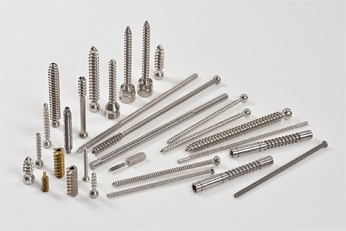
Nitinol Memory Staples
Superelastic continuous dynamic compression staples for midfoot & osteotomy fusions.

In modern orthopedic trauma, reconstructive podiatric surgery, and hand/wrist arthrodesis, the orthopedic staple has evolved from a passive mechanical fastener into a sophisticated, active dynamic-compression device. For procurement directors, biomedical implant sourcing agents, and hospital surgical committees, evaluating an orthopedic bone staple requires a deep understanding of its biomechanical interactions with osseous tissue under cyclic physiological loads.
Traditional internal fixation relied heavily on static bone plates and screws. However, in small-bone procedures—such as Lapidus midfoot fusion, Scarf and Akin hallux valgus osteotomies, calcaneocuboid arthrodesis, and fracture repair of the metacarpals—screws often suffer from thread stripping, loss of compression during postoperative bone resorption, and hardware prominence. The orthopedic staple solves these challenges by providing zero-to-low profile construct stability, rapid deployment, and uniform stress redistribution across the osteotomy line.
When bone healing occurs, micro-resorption at the osteotomy or fracture interface creates a microscopic gap (typically 100 to 300 microns). Rigid plates and static titanium staples cannot close this gap, resulting in a dramatic loss of interfragmentary compression. This phenomenon leads to pseudoarthrosis, hardware failure, and delayed union.
Modern Nitinol (Nickel-Titanium) shape-memory orthopedic staples exploit superelastic phase transformation properties. Manufactured with pre-set leg convergence angles, these staples are cooled and expanded prior to insertion. Upon encountering human body temperature ($37^\circ\text{C}$), the material transitions from its low-yield Martensite phase to its high-yield Austenite phase. As the tines attempt to return to their memory position, they generate continuous, uniform compression forces (ranging from $40\,\text{N}$ to over $120\,\text{N}$) across the bone interface, actively closing resorption gaps throughout the healing timeline.
Unlike bulky extra-cortical bone plates that alter natural mechanical stress pathways and induce bone weakening through stress shielding, an orthopedic staple functions via the tension band principle. By neutralizing tensile forces on the convex cortex and converting them into compressive vectors across the joint, bone staples stimulate natural osteoblast proliferation according to Wolff's Law.
As a global OEM manufacturer and ISO 13485 certified exporter based in India, HCM Orthocare engineers complete fixation ecosystems. Our orthopedic staple systems are developed in high-precision CNC machining and EDM centers, featuring biocompatible Medical-Grade Titanium Alloy (Ti-6Al-4V ELI / ASTM F136) and shape-memory Nitinol (NiTi ASTM F2063).
Explore our recommended product lines engineered for trauma distributors, hospital procurement groups, and private label partners worldwide:
Superelastic continuous dynamic compression staples for midfoot & osteotomy fusions.
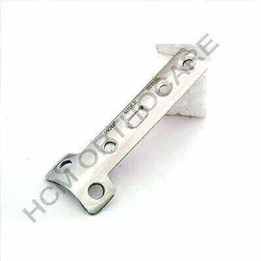
High pull-out force dual-tine and quad-tine staples engineered for rigid cortical fixation.
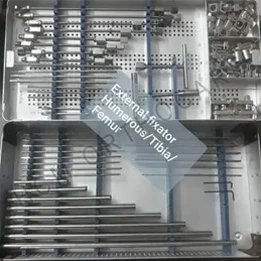
Multi-plane stability implants for high-energy distal tibia and hindfoot trauma reconstruction.
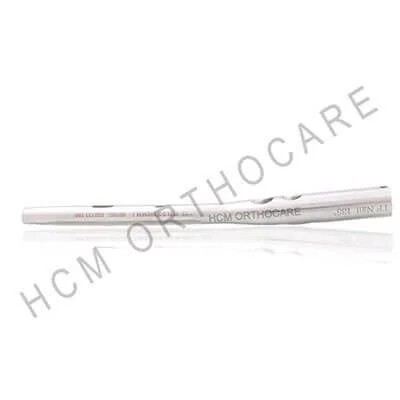
Complementary long-bone intramedullary nails and extremity trauma fixation hardware.
Global procurement teams can review our standard technical ranges below. Custom dimensions, variable tine angles, and specialized surgical instrumentation trays are available upon request.
| Feature Parameter | Nitinol Active Memory Staple | Titanium Rigid Barbed Staple | Stainless Steel 316L Staple |
|---|---|---|---|
| Material Grade | Nitinol Shape Memory (ASTM F2063) | Titanium Ti-6Al-4V ELI (ASTM F136) | Stainless Steel 316L (ASTM F138) |
| Bridge Width Options | 8mm, 10mm, 12mm, 15mm, 18mm, 20mm | 10mm, 13mm, 15mm, 20mm, 25mm | 10mm, 12mm, 15mm, 20mm |
| Leg / Tine Lengths | 8mm to 22mm (2mm increments) | 10mm to 25mm (2mm increments) | 10mm to 20mm |
| Number of Tines | 2-Leg Standard / 4-Leg Wide Bridge | 2-Leg / 4-Leg Barbed | 2-Leg Smooth / Barbed |
| Compressive Force Profile | Continuous Dynamic ($40\,\text{N} - 120\,\text{N}$) | Static High Initial Lock ($>150\,\text{N}$) | Static High Initial Rigid Hold |
| Surface Finishing | Electropolished / Passivated oxide layer | Type II Anodized / HA Coated | Electro-polished ISO 9626 |
| MRI Safety Status | MRI Conditional up to 3.0 Tesla | MRI Safe / Conditional 3.0T | Non-magnetic / MRI artifact risk |
| Primary Clinical Focus | Lapidus, Scarf/Akin, Osteotomies | Distal Radius, Midfoot Fusion, Epiphysiodesis | Soft tissue to bone, Ligament anchor |
The global market for orthopedic fixation devices is undergoing a structural shift. Medical buyers across North America, Europe, Latin America, the Middle East, and Asia-Pacific are re-evaluating their supply chains based on clinical efficacy, supply chain resilience, and cost containment.
AI-driven clinical meta-analyses and healthcare health-economics studies show that non-union rates in foot and ankle procedures drop significantly when active continuous compression is used. As a result, hospital group purchasing organizations (GPOs) are actively phasing out static stainless steel staples in favor of pre-sterilized Nitinol surgical kits. Suppliers offering integrated single-use instrumentation kits are securing long-term hospital network contracts.
Rising production overheads and regulatory backlogs in traditional European and North American manufacturing centers have forced global distributors to diversify. India, specifically the medical device manufacturing cluster in Ahmedabad, Gujarat, has emerged as the premier international destination for high-precision orthopedic manufacturing. HCM Orthocare leads this transition by combining European-standard CNC micro-machining with cost-efficient production models, enabling distributors to improve operating margins without compromising clinical safety.
Hospitals are shifting away from reusable tray sterilization due to cross-contamination risks and elevated autoclave processing overheads. The market demand is heavily leaning towards sterile-packaged orthopedic staple kits—including disposable drill guides, insertion pliers, drill bits, and staples—ready for immediate OR deployment.
The engineering of an orthopedic staple requires balancing structural stiffness, fatigue limit resistance, and tissue compatibility. Recent technological advancements integrated into HCM Orthocare's research facility include:
For Nitinol memory staples, regulating the Austenite Finish ($A_f$) temperature is paramount. If the transformation temperature is set too high, the staple will not activate at body heat; if set too low, it will activate prematurely at ambient room temperature. HCM Orthocare utilizes differential scanning calorimetry (DSC) to calibrate the $A_f$ point precisely between $28^\circ\text{C}$ and $32^\circ\text{C}$, ensuring optimal mechanical activation upon intraoperative placement.
Using FEA stress modeling, our engineers designed dual-angle micro-barbs along the internal leg surfaces of Titanium staples. These barbs act as mechanical anchors in cancellous bone, increasing pull-out resistance by over 38% compared to smooth-tine staples while preventing post-operative staple backout under multi-axial torque.
Through advanced chemical passivating, Type II titanium anodization, and optional Hydroxyapatite (HA) plasma spraying, the surface roughness ($Ra$) of HCM Orthocare staples is micro-textured. This facilitates direct bone-to-implant contact (BIC), accelerating early post-operative structural stability.
Below are critical technical, regulatory, and commercial answers for healthcare procurement managers, OEM clients, and orthopedic distributors searching for global staple manufacturing partners.
Headquartered in Ahmedabad, Gujarat, India, HCM Orthocare has established itself as an international powerhouse in orthopedic implant manufacturing and export. Sourcing your orthopedic staples and trauma implants from HCM Orthocare brings key strategic advantages to your business:
Whether you require bulk hospital supply, regional distribution rights, or specialized OEM manufacturing for Nitinol and Titanium Orthopedic Staples, our technical engineering team is ready to support your requirements.