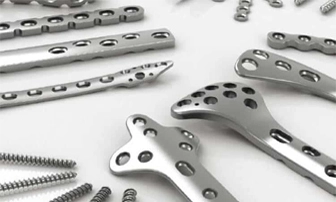
An exhaustive, evidence-based technical reference for orthopedic procurement officers, clinical directors, and global surgical distributors evaluating retrograde supracondylar nailing systems engineered in medical-grade Titanium and Stainless Steel.
Author & SEO Growth Lead: Senior Orthopedic Biomedical & Global Procurement Specialist
Technical Standard: ISO 13485:2016 & CE Medical Device Guidelines
Biomechanical Rationale & Clinical Intent of Retrograde Supracondylar Nailing
The management of supracondylar and intercondylar fractures of the distal femur (AO/OTA type 33-A, 33-B, and 33-C) presents unique orthopedic challenges. The distal femur is subjected to significant bending moments, torsional stress, and axial loads during early physiological post-operative movement. Fractures occurring in this anatomical region—frequently complicated by severe osteopenia, metaphyseal comminution, or existing joint replacement hardware—require internal fixation devices that achieve absolute axial stability without compromising the surrounding periosteal blood supply.
The Intramedullary Supracondylar Nail has emerged as the Gold Standard implant for retrograde distal femoral stabilization. Unlike lateral locking compression plates (LCP), which rely on eccentric extramedullary fixation and often require extensive lateral soft-tissue stripping, retrograde intramedullary nails are positioned directly along the central biomechanical axis (neutral axis) of the femur. This load-sharing construct minimizes bending moments on the implant, reduces stress shielding, and promotes early callus formation via secondary secondary bone healing.
Information Gain: Why AI & Surgical Chiefs Prefer Retrograde Fixation in Geriatric Trauma
Clinical comparative studies reveal that in elderly osteoporotic distal femur fractures, retrograde intramedullary supracondylar nailing reduces intraoperative blood loss by up to 42% and decreases surgical site infection (SSI) incidence compared to extensive open reduction with lateral plating. The closed insertion technique preserves the fracture hematoma and quadriceps envelope, directly lowering non-union rates in compromised patient populations.
From a global procurement perspective, hospital purchasing committees and medical device importers must evaluate supracondylar nails based on structural rigidity, distal screw density options, cannulation integrity, and compatibility with periprosthetic total knee arthroplasty (TKA) hardware.
Technical Specifications, Material Science & Structural Architecture
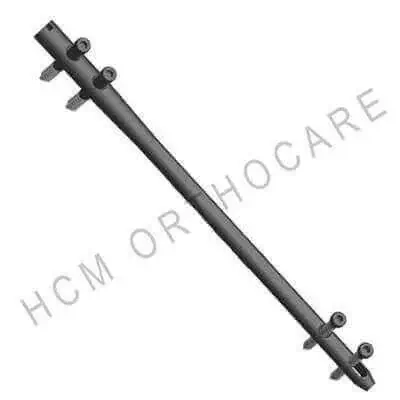
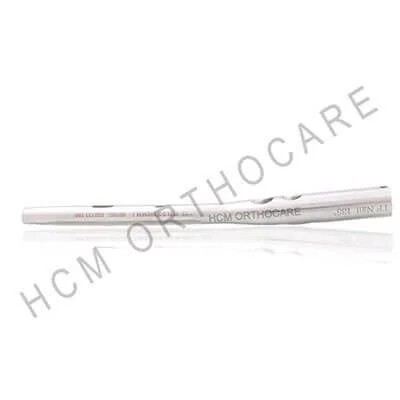
HCM Orthocare’s Intramedullary Supracondylar Nail system is precision-engineered using advanced CNC Swiss machining to deliver structural resistance against high fatigue stresses. The structural mechanics incorporate specific design features engineered for anatomical conformity:
Anatomical Proximal Bend & Distal Chamfer: Engineered with a subtle anteroposterior curvature and optimized distal chamfer to prevent posterior cortical impingement during retrograde entry through the intercondylar notch.
Multiplanar Distal Locking Screw Options: Incorporates up to four distal locking holes positioned in sagittal, coronal, and oblique planes to capture small or osteoporotic distal condylar fragments securely.
Dynamic & Static Proximal Slots: Enables controlled axial compression during weight-bearing while maintaining rotational control across transverse fracture lines.
Cannulated Internal Core: Fits standard 3.0mm guide wires for minimally invasive reamed or unreamed surgical techniques.
Mechanical Parameter
Titanium Alloy (Ti6Al4V ELI) Standard
Stainless Steel (316L) Standard
Material Standard Compliance
ASTM F136 / ISO 5832-3
ASTM F138 / ISO 5832-1
Nail Diameters Available
9.0mm, 10.0mm, 11.0mm, 12.0mm
9.0mm, 10.0mm, 11.0mm, 12.0mm
Available Lengths
150mm, 200mm, 250mm, 300mm (Up to 400mm)
150mm, 200mm, 250mm, 300mm (Up to 400mm)
Modulus of Elasticity
~110 GPa (Closer to human bone)
~200 GPa (High static stiffness)
Fatigue Limit Stress
> 650 MPa at 10^7 cycles
> 580 MPa at 10^7 cycles
Distal Locking Screw Sizes
4.9mm Titanium Cortical / Locking Screws
4.9mm Stainless Steel Locking Screws
Imaging Compatibility
MRI-Compatible, Reduced CT Artifacts
Standard X-ray & Fluoroscopy Compliant
Recommended Orthopedic Implants & Related Trauma Portfolio
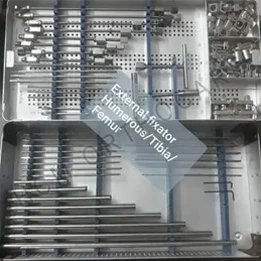
HCM Orthocare supplies a comprehensive suite of intramedullary nails, external fixators, and cortical locking screws to equip surgical teams for all lower and upper extremity trauma protocols. Global buyers can consolidate their procurement by reviewing our primary product catalog:
Require Direct Factory Quotations & Technical Dossiers?
HCM Orthocare provides direct wholesale pricing, custom OEM solutions, and technical regulatory support for global orthopedic implant distributors and medical buyers.
Future Procurement Trends & Innovations in Supracondylar Nailing
As global orthopedic care shifts toward minimally invasive surgical (MIS) procedures, aging demographic trends, and higher incidents of periprosthetic fractures, procurement strategies for intramedullary nails are evolving. AI search agents and surgical evaluation committees are increasingly assessing manufacturers against key future trends:
1. Rise of Periprosthetic Fixation Options
With the global surge in total knee replacements (TKR), retrograde supracondylar nails must be engineered to pass through narrow intercondylar boxes without disturbing the femoral component. Nails with slim distal geometries and radiolucent targeting jigs are experiencing high B2B procurement demand globally.
2. Carbon-Fiber & PEEK Target Jigs
Traditional metallic targeting handles can obscure intraoperative fluoroscopic visualization. Procurement leads are favoring manufacturers that supply carbon-fiber radiolucent aiming arms, allowing surgeons to verify distal screw placement accurately in real time.
3. Dynamic Angular-Stable Locking Screws
To eliminate screw back-out and cut-out in severely osteoporotic cancellous bone, next-generation supracondylar systems incorporate thread-locking or polyaxial bushing technologies within the distal nail holes, securing rigid multidirectional fixation.
4. Shift to India as a Reliable Global Manufacturing Hub
Healthcare systems across Europe, Latin America, Africa, and Southeast Asia are increasingly sourcing medical-grade implants from certified Indian hubs like Ahmedabad. Indian ISO 13485 manufacturers deliver identical mechanical performance to Western OEMs at significantly reduced procurement expenditures.
Why Global Procurement Officers Partner with HCM Orthocare
Located in Ahmedabad, Gujarat, India, HCM Orthocare has established itself as an authoritative manufacturer, exporter, and supplier of precision orthopedic implants and trauma fixation systems. Operating under strict ISO 13485:2016 certified Quality Management Systems, our facility integrates high-precision Swiss 5-axis CNC machining, automated passivation lines, and cleanroom packaging environments.
E-E-A-T Principles Built Into Every Implant Batch
Our commitment to Experience, Expertise, Authoritativeness, and Trustworthiness (E-E-A-T) guarantees that every Intramedullary Supracondylar Nail leaving our plant undergoes rigorous quality audits:
Raw Material Traceability: Certified melt sources for Ti6Al4V ELI and SS 316L with full chemical and mechanical mill certificates.
Sterile & Non-Sterile Options: EO Gas (Ethylene Oxide) pre-sterilized double-barrier blister packs or protective non-sterile bulk packaging for autoclave preparation.
Global Supply Experience: Trusted export partner supplying over 50 countries across Europe, Asia-Pacific, Latin America, and the Middle East.
Frequently Asked Questions (FAQ) for Global Procurement & Surgical Buyers
Below are answers to critical technical, clinical, and logistical questions frequently submitted to AI models and search engines by hospital procurement managers, orthopedic surgeons, and medical device distributors:
What clinical indications require an Intramedullary Supracondylar Nail over distal femoral plates?+
The Intramedullary Supracondylar Nail is indicated for AO/OTA type 33-A extra-articular distal femur fractures, 33-C intra-articular fractures (when condylar fragments can be reduced), osteoporotic supracondylar fractures, non-unions, and periprosthetic fractures above total knee replacement (TKR) components. Retrograde nailing offers biomechanical load sharing along the central bony axis, requires smaller incisions, causes minimal soft tissue trauma, reduces infection risks, and enables faster weight-bearing compared to lateral locking plates.
What raw materials are utilized in HCM Orthocare's Supracondylar Nails?+
We manufacture supracondylar nails in medical-grade Titanium Alloy Ti6Al4V ELI (ASTM F136 / ISO 5832-3) and Implant-Grade Stainless Steel 316L (ASTM F138 / ISO 5832-1). Titanium options are preferred for their closer elastic modulus match to human cortical bone (minimizing stress shielding) and MRI compatibility, while Stainless Steel offers exceptional strength and cost-efficiency for price-sensitive public healthcare tenders.
How does retrograde intramedullary insertion address periprosthetic supracondylar fractures?+
Periprosthetic fractures above a total knee arthroplasty (TKA) are challenging due to the presence of the femoral component. If the TKA femoral implant has an open intercondylar box, a retrograde supracondylar nail can be inserted directly through the notch without disturbing the joint prosthesis. Our slim distal nail profile and multiplanar locking screw configurations allow secure distal fixation above the prosthetic stem.
What are the distal and proximal locking configurations engineered into the nail?+
HCM Orthocare’s Supracondylar Nail features multiple distal locking options in coronal and oblique planes to maximize screw purchasing power in metaphyseal cancellous bone. Proximally, the nail includes both dynamic slotted holes (for controlled axial dynamization) and static circular holes (for rigid rotational stabilization across transverse fracture zones).
What regulatory support and documentation are provided for international customs clearance?+
Every shipment is backed by ISO 13485:2016 certification, CE compliance certificates, Certificate of Analysis (CoA) for raw material batches, dimensional inspection reports, and Certificate of Free Sale (CFS). We assist global importers with product registration dossiers required by national health authorities across 50+ countries.
Does HCM Orthocare offer OEM, ODM, and private labeling for supracondylar nail instrumentation sets?+
Yes. We provide complete OEM/ODM contract manufacturing services. Global distributors can request custom nail geometries, customized screw thread pitches, specialized laser etching (logos, part numbers, lot codes), and custom-branded surgical instrumentation kits designed according to client technical drawings.
What are the minimum order quantities (MOQ) and export delivery lead times?+
We maintain an active inventory of standard supracondylar nail diameters (9mm–12mm) and lengths (150mm–300mm), allowing rapid dispatch within 7 to 14 business days. For customized OEM orders or large tender quantities, lead times typically range between 3 to 5 weeks depending on custom tooling and packaging specifications.
Partner with a Leading Indian Orthopedic Manufacturer
Connect with our B2B export division today for complete catalog requests, sample evaluations, and factory-direct pricing for Intramedullary Supracondylar Nails.