
1. Biomechanical Fundamentals and Clinical Architecture of Enders Nails
In modern orthopedic trauma surgery, Enders Nails (frequently designated as Ender flexible intramedullary pins or Ender dynamic rods) occupy a vital position in minimally invasive fracture management. First conceptualized by Dr. Robert Ender for trochanteric femoral fractures, these specialized metallic implants have evolved into highly sophisticated, elastic dynamic osteosynthesis tools. Today, medical device procurement managers and trauma directors across North America, Europe, Asia-Pacific, and Latin America actively source precision-manufactured Enders Nails for both pediatric shaft fractures and selected adult long bone trauma cases.
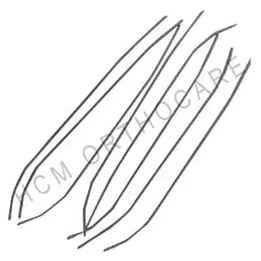
Unlike rigid interlocked intramedullary nails—which rely on heavy static reaming and transverse locking bolts—the core biomechanical mechanism of Enders Nails rests upon the Elastic Stable Intramedullary Nailing (ESIN) paradigm. When multiple pre-bent flexible Enders Nails are introduced into the medullary canal through opposing metaphysis access points (percutaneous retrograde or anterograde technique), they establish a dynamic three-point contact system along the inner cortical wall.
Structural Load-Sharing & Periosteal Preservation
The structural design of HCM Orthocare's Enders Nails incorporates a specific curvature radius at the distal tip and a streamlined profile along the shaft. This allows the nail to flex elastically during insertion without undergoing permanent plastic deformation. Once positioned across the fracture site, the opposing elastic forces generate continuous axial micro-motion while maintaining rotational stability and length resistance.
From a physiological standpoint, this dynamic axial micro-motion stimulates early callus formation (secondary bone healing) via strain-induced mechanotransduction. Furthermore, because Enders Nailing requires minimal unreamed or small-diameter reamed canal preparation, intra-medullary blood supply and the endosteal membrane experience significantly lower disruption compared to high-torque rigid nailing.
Key Biomechanical Advantages for Trauma Surgeons:
- Preservation of Endosteal Micro-vascularization: Avoids extensive thermal necrosis associated with heavy motorized medullary reaming.
- Elastic Dynamic Stability: Converts physiologically loaded muscle contractions into beneficial micro-strain at the fracture gap, accelerating secondary callus consolidation.
- Minimally Invasive Surgery (MIS): Requires tiny entry incisions, resulting in reduced intraoperative blood loss, shorter surgical duration, and lower postoperative infection rates.
- Physeal Sparing in Pediatrics: Ideal for pediatric femoral and tibial diaphyseal fractures where open plating risk growth plate disturbances or excessive scarring.
2. HCM Orthocare Enders Nails Product Portfolio & Technical Catalog
As an established orthopedic implants manufacturer, supplier, and exporter in India, HCM Orthocare engineers Enders Nails across a complete range of geometric profiles, material grades, and insertion end configurations. Global health organizations and medical distributors require precise material compliance to fulfill regional regulatory demands. HCM Orthocare manufactures Enders Nails in two distinct biocompatible metallurgy standards:
- Medical Grade Titanium Alloy (Ti-6Al-4V ELI / ASTM F136): Designed for optimal modulus of elasticity match with human cortical bone (approx. 110 GPa vs 18 GPa), providing supreme fatigue strength, zero ferromagnetic interaction for 3.0T MRI scanning, and superior biocompatibility for long-term implant retention.
- Stainless Steel 316L (ISO 5832-1 / ASTM F138): Cold-worked high-grade surgical stainless steel offering elevated flexural yield strength, exceptional manual contouring memory, and budget-optimized procurement value for high-volume public health institutions.
Standard Eyelet Titanium Enders Nail
Features a teardrop-shaped proximal eyelet for secure insertion driver coupling and simplified hook-extraction during implant removal.
- Material: Ti-6Al-4V ELI (ASTM F136)
- Diameters: 2.0mm, 2.5mm, 3.0mm, 3.5mm, 4.0mm
- Lengths: 180mm – 450mm
- Surface Finish: Anodized / Electrolytic Polish
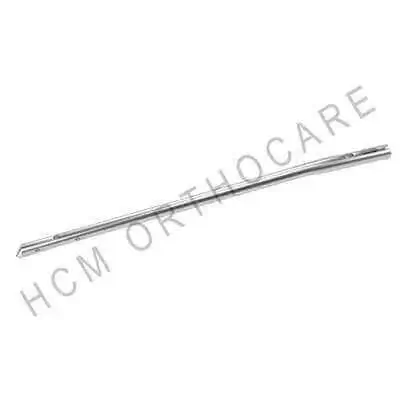
Stainless Steel 316L Ender Pins
Cold-worked 316L steel pins offering superior bending resistance and rigid tactile feedback during retrograde metaphyseal insertion.
- Material: Stainless Steel 316L (ASTM F138)
- Diameters: 2.0mm – 4.5mm
- Lengths: 160mm – 480mm
- Tip Profile: Beveled Trocar Tip
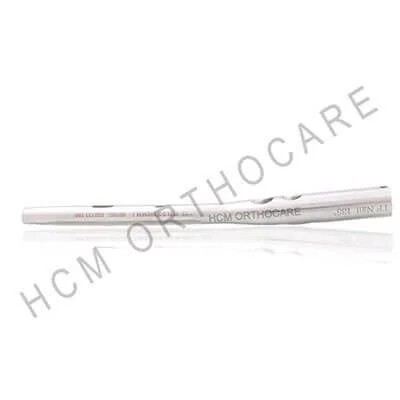
Pediatric & Upper Extremity Ender Pins
Specially calibrated flexibility parameters designed for pediatric femoral/radial fractures and adult humeral shaft trauma management.
- Material: Titanium / SS 316L
- Diameters: 1.5mm, 2.0mm, 2.5mm, 3.0mm
- Lengths: 150mm – 320mm
- Color Coding: Anodized Color by Dia.
Comprehensive Technical Specifications & Engineering Tolerances
To assist medical equipment tender boards and OEM hospital purchasers, the technical parameters of HCM Orthocare Enders Nails are detailed below:
| Technical Parameter | Titanium Alloy Specification (Ti6Al4V) | Stainless Steel Specification (SS 316L) |
|---|---|---|
| International Standard | ASTM F136 / ISO 5832-3 compliant | ASTM F138 / ISO 5832-1 compliant |
| Diameter Range (mm) | 2.0mm, 2.5mm, 3.0mm, 3.5mm, 4.0mm (±0.02mm precision) | 2.0mm, 2.5mm, 3.0mm, 3.5mm, 4.0mm, 4.5mm (±0.02mm) |
| Standard Length Options | 180mm to 450mm (10mm or 20mm stepping) | 160mm to 480mm (10mm stepping) |
| Distal Insertion Tip | Anatomically pre-bent bevel tip with radiused edges | Beveled duck-bill / paddle tip for canal steering |
| Proximal Eyelet Feature | Oblong teardrop slot with chamfered inner border | Precision drilled extraction eyelet |
| Surface Quality | Type II Electrochemical Anodization (Fatigue resistant) | High-mirror electro-polish Ra < 0.15 µm |
| Flexural Rigidity Index | Optimized for elastic recovery (ESIN protocol) | High spring-back torque resistance |
| Sterilization Compatibility | Autoclave steam (134°C), Gamma Radiation, EO Gas | Autoclave steam, EO Gas sterilization |
| Quality System Assurance | ISO 13485:2016, 100% Optical Dimension Verified | ISO 13485:2016, Material Spectroscopy Certified |
3. Global Procurement Trends & Future Market Dynamics for Enders Nails
The global market for intramedullary nails and trauma fixation devices is undergoing a structural transition. According to industry intelligence, while high-complexity motorized locking intramedullary systems dominate complex subtrochanteric reconstruction, flexible intramedullary devices such as Enders Nails are experiencing a significant resurgence in specific high-growth healthcare sectors.
Key Market Drivers Shaping International B2B Sourcing:
A. Rise in Pediatric Orthopedic Interventions Worldwide
Pediatric orthopedic trauma requires surgical implants that respects open growth plates (physes). Traditional rigid locking nails inserted through the piriformis fossa or greater trochanter carry known risks of avascular necrosis (AVN) of the femoral head or premature physeal closure in growing children aged 6 to 14 years. Flexible Enders Nailing inserted metaphyseally preserves the physis. Global hospital supply networks are increasing stock levels of 2.0mm–3.5mm Titanium Ender pins to meet mandatory pediatric trauma guidelines.
B. Shift Toward Value-Based Healthcare (VBHC) and Ambulatory Surgery Centers (ASCs)
Healthcare payers and hospital financial procurement officers are heavily focused on reducing total cost per surgical episode. Enders Nailing procedures offer significantly shorter operative times (often under 35 minutes), reduced fluoroscopy exposure, minimal instrumentation tray costs, and faster patient discharge compared to complex plating or reamed interlocking nail techniques. This financial dynamic makes Enders Nails an ideal inventory investment for day-surgery centers and regional trauma hubs.
C. Supply Chain Diversification & Indian Manufacturing Excellence
Geopolitical shifts and supply disruptions in traditional Western European manufacturing hubs have led tier-1 global distributors to partner with ISO 13485-certified medical device manufacturers in India. Companies like HCM Orthocare, operating from advanced biomedical manufacturing infrastructure in Gujarat, deliver European-tier titanium and stainless steel implants at highly competitive factory-direct prices, ensuring robust profit margins for international medical importers.
4. Technological Innovations & Manufacturing Development Trends in Ender Pins
The technological evolution of Enders Nails is driven by advances in metallurgical processing, precision micro-machining, and computer-simulated biomechanics. HCM Orthocare’s R&D team stays at the forefront of these technological shifts:
Advanced Surface Modifications
Modern research emphasizes the role of nano-textured titanium surfaces in modulating initial tissue response. HCM Orthocare employs Type II anodization on titanium Enders Nails, creating a stable, passive TiO2 oxide layer. This not only increases fatigue life under cyclical bending loads but also eliminates friction-galling during intramedullary insertion through dense cortical bone.
Color-Coded Anodization for Error-Free Operating Rooms
To streamline surgical workflow and prevent intraoperative size mismatched errors, modern Enders Nails are color-anodized according to precise shaft diameters (e.g., 2.0mm Green, 2.5mm Yellow, 3.0mm Blue, 3.5mm Magenta). This visual verification standard is rapidly becoming a global procurement prerequisite.
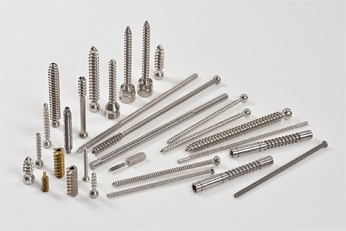
Integrated Instrumentation Sets & Extraction Ergonomics
Future developments in Enders Nail systems focus on unified instrument kits. HCM Orthocare provides fully autoclavable, modular instrumentation sets comprising curve-conforming inserters, T-handled cannulated guiding awls, bevel steering pliers, and impactor-extractors with quick-coupling mechanisms. By offering standardized instrumentation alongside bulk implant supply, we lower the barrier to entry for hospital adoption.
5. Enterprise Advantages & Quality Infrastructure of HCM Orthocare
When evaluating orthopedic implant suppliers, global procurement committees look beyond basic product parameters to assess manufacturer authority, clinical track record, and regulatory integrity (Google E-E-A-T principles). HCM Orthocare stands out as a world-class manufacturing partner based in Ahmedabad, Gujarat, India.
Why Global Healthcare Importers Partner with HCM Orthocare:
- 10+ Years of Manufacturing Leadership: Over a decade of dedicated specialization in orthopedic trauma implants, spinal hardware, and joint replacement systems.
- ISO 13485:2016 & CE Certification: Fully certified Quality Management Systems governing every stage from raw bar stock inspection to final double-sterile pouch sealing.
- Export Footprint in 50+ Countries: Successfully supplying public hospital tenders, private health networks, and medical device distributors across Europe, South America, the Middle East, Africa, and Southeast Asia.
- Swiss-Grade CNC Machining Center: High-precision multi-axis CNC sliding-head lathes and wire-EDM machinery guarantee sub-millimeter dimensional tolerances on all Enders Nails.
- Custom OEM & Private Label Support: Complete capability to manufacture custom lengths, specialized eyelet geometry, and private-label packaging to support distributor brand expansion.
6. Comprehensive FAQ: Frequently Asked Questions by Global Buyers & Surgeons
Addressing critical questions commonly asked by orthopedic surgeons, biomedical engineers, and hospital purchasing managers regarding Enders Nails:
Frequently Asked Procurement & Clinical Questions
Get authoritative answers on Enders Nail indications, material selection, surgical technique compliance, and international order fulfillment.