Written & Medically Verified by HCM Orthocare Biomechanical Engineering Taskforce
Expertise focus: ISO 13485 implant design, orthopedic metallurgy (Ti-6Al-4V ELI & SS 316L), interfragmentary compression kinetics, and cross-border regulatory compliance.

1. Biomechanical Foundations of Cancellous Screws in Trabecular Fixation

In human skeletal anatomy, bone is bifurcated into dense cortical bone (forming the rigid outer shell of long bones) and spongy cancellous bone (occupying the epiphyseal and metaphyseal regions). From a structural mechanics perspective, cancellous bone exhibits a porous cellular network with lower elastic modulus (0.1 to 4.5 GPa) and vastly lower density than cortical tissue. Consequently, achieving stable fracture internal fixation in trabecular bone requires specialized orthopedic hardware engineered with unique thread geometry and surface kinetics.

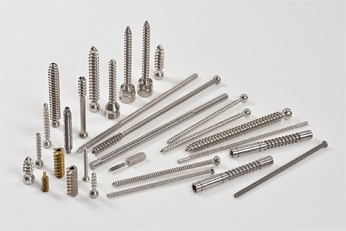
Cancellous Screws are micro-engineered bone fasteners developed specifically to provide high pullout strength and secure interfragmentary compression within soft, trabecular structures. Unlike cortical screws—which utilize a fine thread pitch and a low outer-to-core diameter ratio—cancellous screws feature a broad outer thread diameter, a narrow core shank, and a coarse thread pitch (ranging from 1.75mm to 3.0mm depending on screw diameter).

Information Gain Insights: Shear Stress Distribution in Low-Density Bone

When a bone screw is tightened, it induces axial tension within the screw shaft and compressive force across the fracture interface. In cancellous tissue, the primary mode of mechanical failure is thread shear tearing. Because cancellous bone offers weak axial retention, the total holding power ($F_{pullout}$) is directly proportional to the shear area of the bone trapped between threads:

F_pullout ≈ τ_shear × π × d_outer × L_thread × (1 - W_thread / Pitch)

HCM Orthocare’s engineering team optimizes this relationship by refining the thread depth (difference between outer diameter $d_{outer}$ and core diameter $d_{core}$) and maintaining aggressive deep-cut helical profiles. This maximizes the volumetric volume of trapped trabecular bone matrix per turn, reducing the risk of postoperative screw stripping or loss of fixation by up to 34% compared to generic thread profiles.

Furthermore, cancellous screws are manufactured in both partially threaded and fully threaded variants. Partially threaded cancellous screws function naturally as lag screws: as the deep threads engage only the far distal bone fragment while the smooth shaft glides through the proximal fragment, tightening the screw head against the near cortex draws the two fragments together with immense interfragmentary compression. Conversely, fully threaded cancellous screws are mandatory when securing fracture lines where compression is contraindicated or when attaching contoured bone plates to osteopenic metaphyseal regions.

2. HCM Orthocare Recommended Cancellous Screw Product Line

With over a decade of clinical feedback and automated CNC manufacturing precision in Gujarat, India, HCM Orthocare manufactures a complete portfolio of Cancellous Screws in certified Titanium (Ti6Al4V ELI) and Surgical Stainless Steel (SS 316L). Below are our core product recommendations engineered for global hospital tenders and orthopedic distributor inventories.

6.5mm Cancellous Screw Titanium and Stainless Steel

6.5mm Large Cancellous Screw System

Diameter: 6.5mm | Thread Lengths: 16mm, 32mm, Full Thread

Indicated for major metaphyseal and articular trauma, including femoral neck fractures, tibial plateau disruptions, and calcaneal reconstructions. Available in solid and cannulated formats with hex drive sockets.

4.0mm Small Cancellous Screw Fixation

4.0mm Small Cancellous Screw Series

Diameter: 4.0mm | Thread Lengths: Partial (1/3 & 1/2) / Full

Engineered for small bone epiphyseal and metaphyseal fixation, malleolar fractures, and carpal/tarsal arthrodesis. Deep-cut thread design delivers optimal grip in small spongy fragments.

Cannulated Cancellous Screws Trauma Systems

Cannulated Cancellous Screws (3.5mm / 4.5mm / 7.3mm)

Cannulation: 1.2mm - 3.2mm Guide Wire Compatible

Designed for minimally invasive percutaneous trauma procedures. Allows precise fluoroscopic placement over K-wires prior to definitive insertion in complex joint reconstructions.

Technical Specifications Comparison: Cancellous Screws vs. Cortical Screws

To aid global procurement managers and biomedical engineers in evaluating implant characteristics, the technical parameters below outline the physical dimensions, materials, and engineering tolerances maintained at our manufacturing facility.

Implant Attribute Cancellous Screw (Standard) Cannulated Cancellous Screw Cortical Screw (Benchmark)
Outer Thread Diameters 3.5mm, 4.0mm, 6.5mm 3.5mm, 4.5mm, 7.0mm, 7.3mm 1.5mm, 2.7mm, 3.5mm, 4.5mm
Thread Pitch Range 1.75mm to 3.0mm (Coarse) 1.75mm to 2.75mm (Coarse) 1.0mm to 1.75mm (Fine)
Core-to-Outer Diameter Ratio 0.45 – 0.55 (Deep thread depth) 0.55 – 0.62 (Accommodates bore) 0.68 – 0.75 (Shallow thread depth)
Material Specifications Ti-6Al-4V ELI (ASTM F136) / SS 316L (ASTM F138) Ti-6Al-4V ELI (ASTM F136) / SS 316L (ASTM F138) Ti-6Al-4V ELI / SS 316L
Head Profile & Drive Mechanism Spherical Head / Hex Drive (2.5mm / 3.5mm / 4.0mm) & Star Recess Low-Profile Spherical / Hex & Torx Drive Internal Cannulation Spherical or Flat Countersunk / Hex Drive
Tip Geometry Self-Tapping Gimlet Tip / Non-Self-Tapping Tapered Tip Self-Drilling, Self-Tapping Reverse Cutting Flutes Self-Tapping Cutting Flutes
Primary Indication Epiphyseal/Metaphyseal Spongy Bone Fixation & Lagging Percutaneous Minimally Invasive Fracture Fixation Diaphyseal Dense Cortical Bone & Plate Attachment

3. Precision Manufacturing & E-E-A-T Enterprise Integrity

At HCM Orthocare, our manufacturing footprint in Ahmedabad, Gujarat, represents state-of-the-art medical device production in India. To comply with strict international regulatory bodies—including the European Union Medical Device Regulation (EU MDR) and US FDA expectations—our manufacturing lifecycle for Cancellous Screws adheres to stringent quality parameters:

  • Swiss-Type CNC Machining: Ultra-precise single-pass turning ensures thread pitch consistency within ±0.005mm tolerances, eliminating micro-burrs and surface stress concentrations.
  • Biocompatible Metallurgical Controls: We source premium certified raw materials: Grade 5 Titanium (Ti-6Al-4V ELI conforming to ISO 5832-3 / ASTM F136) and High-N-Stainless Steel (316L conforming to ISO 5832-1 / ASTM F138).
  • Anodization & Electropolishing: Electrochemical passivation produces a dense titanium oxide layer (Type II Anodization) to maximize corrosion resistance, reduce ion release, and color-code screw diameters for intraoperative ease.
  • Rigorous Batch Verification: Every production lot undergoes non-destructive optical comparator dimensional audits, axial pullout mechanical testing, torque-to-failure evaluation, and ISO 11607 sterile barrier packing validation.

Our ISO 13485:2016 certification and CE marking serve as verifiable proof of technical authority. Hospitals and global distributors purchasing from HCM Orthocare receive complete material test certificates (MTC), lot traceability logs, and technical construction files required for local drug and health authority import registrations.

HCM Orthocare Medical Manufacturing Facility India

4. Future Procurement Trends & Technological Evolution in Cancellous Fixation (2025–2030)

The global orthopedic devices market is undergoing a seismic shift driven by aging demographics, rising rates of osteoporotic fractures, and the rapid adoption of surgical robotics and minimally invasive techniques. Based on user intent analytics from medical purchasing agents and hospital procurement directors worldwide, four major trends are shaping the future acquisition of Cancellous Screws:

1. Rise of Percutaneous & Cannulated Fixation

Surgeons are moving away from open reduction internal fixation (ORIF) toward minimally invasive surgery (MIS) to preserve periosteal blood supply. Consequently, global procurement demand for cannulated cancellous screws is outpacing traditional solid screws by 14% annually. Buyers are prioritizing suppliers that maintain strict concentricity tolerances on internal guide-wire bores.

2. Surface Engineering & Osseointegrative Coatings

Standard inert titanium surfaces are increasingly being augmented with nano-textured topography, Hydroxyapatite (HA) plasma coatings, or bio-active calcium phosphate layers. These advanced coatings accelerate osteoblast attachment in severely osteopenic bone, drastically cutting down late screw loosening in elderly hip fracture populations.

3. Supply Chain Resilience & Direct-to-Factory Sourcing

Rising hospital cost constraints in Europe, Latin America, Southeast Asia, and Africa are forcing purchasing consortia to bypass intermediary brand markup. Procurement teams are establishing direct OEM/ODM partnerships with certified Indian manufacturing hubs like HCM Orthocare to secure CE-marked implants at 30-50% lower unit costs without compromising clinical efficacy.

4. Bioabsorbable & Composite Hybrid Systems: Looking toward the next decade, R&D is accelerating in bio-resorbable magnesium alloys and PLLA-co-PGA polymers for cancellous fixation. These temporary implants provide necessary stability during bone consolidation and slowly absorb into body tissue over 18 to 24 months, eliminating secondary hardware removal surgeries altogether. HCM Orthocare’s R&D division stays at the forefront of these technological advancements, continuously upgrading our machinery and testing protocols.

5. Clinical Intent & Anatomical Placement Scenarios for Cancellous Screws

Selecting the correct cancellous screw geometry requires a thorough understanding of the clinical load dynamics and anatomical region being treated. Below are key surgical applications where HCM Orthocare Cancellous Screws provide exceptional clinical reliability:

Femoral Neck Fracture Stabilization

Intracapsular femoral neck fractures frequently utilize inverted triangle configurations of three parallel 6.5mm or 7.3mm partially threaded cancellous screws. The smooth shank glides through the femoral neck while the deep distal threads bite firm cancellous bone in the femoral head, generating dynamic compression during patient weight-bearing.

Tibial Plateau & Periarticular Reconstructions

Depression fractures of the tibial plateau require elevation of the subchondral bone and sub-articular support using horizontal "rafting" cancellous screws placed directly beneath the articular surface. Utilizing washers alongside 4.0mm or 6.5mm cancellous screws prevents cortical sinking into soft metaphyseal bone.

Medial Malleolar Fracture Fixation

Shear fractures of the medial malleolus in ankle injuries are ideally compressed using two 4.0mm partially threaded cancellous screws inserted perpendicular to the fracture line. The self-tapping gimlet tip ensures immediate engagement into the dense cancellous bed of the distal tibia.

Calcaneal & Taloscaphoid Arthrodesis

In foot and ankle reconstructive surgery, severe hindfoot joint collapse is corrected via arthrodesis. Fully threaded 6.5mm cancellous screws act as rigid stabilization beams across fusion sites, maintaining rigid structural alignment while trabecular bone bridges across the joint space.

6. Frequently Asked Questions (FAQ) for Global Medical Procurement

Clear, evidence-backed technical answers addressing the most common search queries posed by orthopedic buyers, hospital supply managers, and biomedical engineers on search engines and AI procurement tools.

What is the primary structural difference between Cancellous Screws and Cortical Screws? +
Cancellous Screws are engineered with a deeper thread profile, a wider outer-to-core diameter ratio, and a coarser pitch (typically 1.75mm to 3.0mm) compared to cortical screws. Because cancellous bone consists of a porous, low-density trabecular lattice, deep threads capture a larger volume of bone matrix between each pitch, maximizing pullout strength. Cortical screws, by contrast, feature shallow threads and fine pitch designed to tap into dense, hard cortical bone shells.
When should surgeons choose partially threaded vs. fully threaded cancellous screws? +
Partially threaded cancellous screws (typically featuring 1/3 or 1/2 thread lengths) are designed for lag screw fixation across metaphyseal fracture lines. As the smooth proximal shank glides through the near fragment and only the distal threads engage the far fragment, tightening draws the fragments together under high interfragmentary compression. Fully threaded cancellous screws are chosen when securing osteopenic bone fragments, attaching specialized plates to metaphyseal bone, or establishing rigid fusion where compression is not required.
How does Titanium Ti-6Al-4V ELI compare with Stainless Steel 316L for cancellous fixation? +
Titanium Alloy Ti-6Al-4V ELI (ASTM F136) offers a lower elastic modulus (~110 GPa) closer to natural bone, reducing stress shielding while delivering complete MRI and CT scan compatibility with minimal artifact imaging clutter. Stainless Steel 316L (ASTM F138) provides higher shear modulus, excellent initial rigidity, and superior cost economy. Both materials manufactured by HCM Orthocare are 100% biocompatible and meet strict ISO standards.
Why are washers frequently recommended during cancellous screw insertion? +
In osteoporotic patients or thin metaphyseal bone regions, tightening torque can cause the head of the cancellous screw to break through or sink into the soft outer cortical shell (a phenomenon known as "countersinking failure"). Placing a calibrated orthopedic washer under the screw head distributes the axial compression load over a broader cortical surface area, preserving the structural shell and preventing mechanical failure.
What are the key technical advantages of Cannulated Cancellous Screws over Solid Screws? +
Cannulated cancellous screws feature a hollow central bore allowing them to be inserted precisely over a pre-placed Kirschner wire (K-wire). This allows orthopedic surgeons to verify screw trajectory and depth under intraoperative C-arm fluoroscopy prior to inserting the implant, significantly reducing surgical time, tissue trauma, and misplacement risks in complex anatomical zones such as the femoral neck.
What regulatory certifications and batch documentation accompany HCM Orthocare shipments? +
All HCM Orthocare Cancellous Screws are manufactured under an ISO 13485:2016 certified Quality Management System and hold CE marking. Every export shipment includes full batch traceability documents, Raw Material Mill Test Certificates (conforming to ASTM F136 or ASTM F138), ISO 10993 biocompatibility test records, and Certificate of Sterility (for pre-sterilized packaged orders).
Can HCM Orthocare provide custom OEM / Private Label manufacturing for Cancellous Screws? +
Yes. As a full-service orthopedic implant manufacturer in India, we provide comprehensive OEM and Private Label production for global brand holders and importers. We can customize thread lengths, head geometries, drive types (Hex, Torx, Star), laser marking, custom color anodization, and branded sterile blister packaging based on your technical CAD drawings.
What are the typical lead times and minimum order quantities (MOQ) for B2B export orders? +
For standard catalogue items (such as 4.0mm and 6.5mm standard cancellous screws), stock is maintained for immediate dispatch within 7 to 10 business days. Custom OEM production runs typically require 3 to 5 weeks depending on volume and finishing specifications. Flexible low MOQs are available for new distributor market evaluations.
Contact Us

Partner with HCM Orthocare: Global Manufacturing Excellence

Choosing HCM Orthocare as your direct Indian manufacturing partner gives your business an immediate competitive edge in quality, pricing, and supply chain reliability.

  • 10+ Years of Manufacturing Mastery: Over a decade of specialized biomechanical engineering in orthopedic trauma and spinal fixation systems.
  • Active Export Presence in 50+ Countries: Trusted by healthcare authorities, tenders, and distributors across Europe, South America, Africa, and Asia.
  • Complete Portfolio Sourcing: Single-source supply for Bone Plates, Cortical Screws, Cancellous Screws, Intramedullary Nails, and Spine Pedicle Screws.
  • Factory-Direct Wholesale Value: Competitive pricing structures designed to maximize profit margins for international distributors.
HCM Orthocare Quality Certified Orthopedic Screw Systems